
Stop the Shivers by Locating Your Atwood Furnace Flame Sensor

Updated: Jul 31
When Your RV Furnace Keeps Shutting Off, the Flame Sensor Is Usually Why

The atwood furnace flame sensor location surprises most RV owners — because it isn't a separate part sitting near the burner. Here's the quick answer:
Where is the flame sensor on an Atwood furnace?
On most Atwood models, the flame sensor is part of the igniter electrode assembly, located inside the burner box
The electrode tip extends into the flame path and doubles as both the igniter and the flame sensor
It connects back to the control board via a single high-voltage wire
The flame completes a ground circuit through the burner to the board — this is how the board "knows" the flame is lit
On 7900, 8000, 8500, and DFMD series furnaces, you access it by removing the front grille or outer access door
There is no standalone "flame sensor rod" separate from the igniter on Atwood furnaces. If your furnace lights for a few seconds and then shuts off, the electrode assembly and control board are the first places to look.
Cold nights in an RV with a furnace that won't stay lit are no fun — and the fix is usually simpler than it seems once you know where to look. Whether your furnace is clicking away without igniting or locking out after a few seconds of flame, understanding how the flame sensing system works is the fastest path to getting heat back.
I'm Adam Wettach, owner of Admiral Plumbing, Heating & Cooling, and my hands-on experience diagnosing ignition and flame sensing failures across residential and RV heating systems makes atwood furnace flame sensor location one of those topics I can walk you through step by step.
Let's get your furnace running reliably again.

Understanding the Atwood Furnace Flame Sensor Location
To understand why the atwood furnace flame sensor location is designed the way it is, you have to understand a process called flame rectification.
In older pilot-light furnaces, a thermocouple sat directly in the flame, generating a small electrical current to keep the gas valve open. Modern Atwood (and newer Dometic) RV furnaces use an electronic direct spark ignition (DSI) system.
In these systems, the ignition electrode assembly inside the burner box wears two hats: it creates the high-voltage spark to light the propane, and then it immediately switches roles to act as the flame sensor.
When the burner ignites, the heat of the flame ionizes the air around the electrode. This ionized air acts like a weak diode, allowing a tiny, low-voltage alternating current (AC) sent from the control board to flow through the flame to the grounded burner assembly, converting it to a direct current (DC) signal.
This microamp/microvolt signal travels back to the circuit board. If the board does not detect this completed ground circuit within about 6 to 8 seconds of ignition, it shuts off power to the gas valve to prevent unburned propane from pooling in your RV.
Because the system relies on this delicate electronic loop, any disruption—whether it is rust on the burner, soot on the electrode tip, or corrosion on the connecting wire—will break the circuit and cause a lockout. You can read more about how these circuits are mapped out in the official Atwood Service Department Manual.
Finding the Atwood Furnace Flame Sensor Location on Different Models
Because Atwood has manufactured several furnace families over the decades, how you access and identify the electrode assembly depends entirely on your specific model.
Finding the Atwood Furnace Flame Sensor Location on 7900 and 8000 Series
The Atwood 7900 and 8000 series (such as the popular 7912, 7916, 8012, and 8016 models) are highly compact, low-draw units. In fact, the 8012 model draws only 1.8 amps, while the 79 series draws about 3.4 amps.
On these models, there is typically no exterior access door on the outside of your RV. Instead, you must service the unit from the inside:
Remove the front plastic or metal grille inside the RV living space.
Locate the burner box cover plate, which is held in place by a few screws.
Once the cover plate is off, you will see the single-wire or two-wire electrode assembly mounted directly into the side of the burner chamber.
The tip of this electrode hangs out into the flame path right at the burner head.
For step-by-step schematics of these compact units, you can refer to the Atwood HydroFlame Master Service Manual.
Finding the Atwood Furnace Flame Sensor Location on 8500 and DFMD Series
The larger Atwood 8500 series (ranging from 16,000 to 34,000 BTUs) and the newer DFMD (Dometic Furnace Medium Duty) series are serviced almost exclusively from the outside of the RV.

Open the exterior painted access door on the side of your rig.
Locate the combustion blower housing and the metal burner box.
The electrode assembly (often listed as Part #24 in Atwood parts breakdowns) is mounted to the front face of the burner box with a single 1/4" hex screw.
It is positioned precisely so that its metal probes sit directly in the path of the gas discharge ports.
Symptoms of a Dirty or Faulty Atwood Flame Sensor
When the flame sensor fails to do its job, the furnace exhibits a very specific, predictable behavior known as the three-try lockout:
The Call for Heat: The thermostat clicks, and the blower motor starts up to purge the combustion chamber.
Sail Switch Engages: The airflow pushes the sail switch closed, telling the control board it is safe to ignite.
The Spark: You will hear a rapid clicking sound (the DSI electrode sparking) and a "clunk" as the gas valve opens.
Brief Ignition: The burner ignites, and you will feel a brief wave of hot air from the exhaust.
The Drop-Out: After 3 to 8 seconds, the flame suddenly dies.
The Cycle Repeats: The furnace will purge itself, try to light a second time, and then a third time.
Lockout: After three failed attempts to sense a flame, the control board locks out for safety. The blower may continue to run to cool the unit down, but no more gas will flow.
On newer Atwood models equipped with an LED diagnostic light on the control board, a flame sensing failure will trigger a Code 3 error (typically three flashes followed by a pause). If your home heating system is acting up in a similar fashion, check out our guide on the Top 5 Common Furnace Problems and How to Fix Them.
How to Test, Clean, and Replace Your Atwood Flame Sensor
Working on an RV furnace requires caution. Before attempting any DIY repairs, always observe these safety precautions:
Turn off the propane supply at your RV's main LP tanks.
Disconnect the 12V DC power supply (either by pulling the furnace fuse, turning off the battery disconnect switch, or disconnecting the shore power).
Ensure the furnace has cooled completely if it was recently running.
Testing the Flame Sensor Signal
To determine if the issue lies with the electrode itself or the control board, you can perform a quick diagnostic test using a digital multimeter.
Inspect the high-voltage wire running from the control board to the electrode. Look for cracks, burn marks, or corrosion at the terminals. A corroded connector can easily block the delicate microamp signal.
Set your multimeter to the DC millivolt scale.
Connect one lead to the burner ground and the other to the flame sensor wire terminal (this is easiest to do with a specialized inline test adapter, as outlined in the Atwood Furnace Training Manual).
When the burner ignites, you should see a reading of approximately 0.48V DC (480 millivolts) or higher. If the flame is burning bright and engulfing the sensor but your reading is zero or highly erratic, the sensor rod is dirty or the wire is compromised.
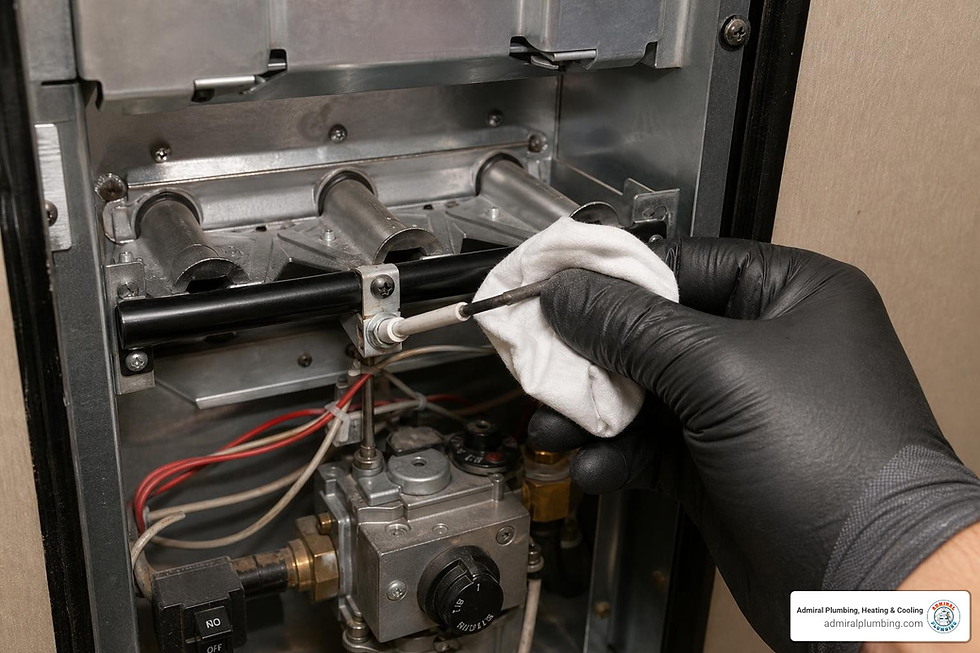
Cleaning the Electrode Rod
Over time, the burning of propane leaves behind a thin, invisible layer of carbon and silica on the metal probe. This buildup acts as an electrical insulator, preventing the microvolt signal from reaching the control board.
Remove the mounting screw holding the electrode assembly in the burner box.
Carefully pull the assembly out, taking care not to crack the white ceramic insulator surrounding the metal rods.
Inspect the metal tips. If they are covered in black soot or white oxidation, use a piece of ultra-fine steel wool or emery cloth to gently polish the metal until it is bright and clean.
Never use coarse sandpaper or a wire brush, as these can leave deep scratches that trap carbon and accelerate future failure. For more tips on maintaining flame sensors, read our guide on the Aire Flo Furnace Flame Sensor.
Replacing the Igniter and Sensor Assembly
If the ceramic insulator is cracked, the metal probe is severely rusted or bent out of shape, or if cleaning it doesn't resolve the lockout, you will need to replace the assembly.
Step | Action | Key Detail |
1 | Disconnect the wire | Pull the high-voltage wire off the old electrode terminal. |
2 | Unbolt the assembly | Remove the 1/4" mounting screw and lift the old unit out. |
3 | Check the spark gap | Ensure the gap between the two probes (or the probe and the burner) is exactly 1/8 inch (3.2 mm). |
4 | Install the new unit | Insert the new electrode, tighten the mounting screw, and reconnect the wire. |
If you are upgrading an older Atwood furnace that used a two-wire setup (separate spark and sense wires) to a newer control board, you may need to install a modern single-wire igniter/sensor assembly to ensure compatibility.
Other Components That Mimic Flame Sensor Failures
Before you buy a new electrode or control board, be aware that several other furnace components can cause the exact same "lights for 3 seconds, then dies" symptom.
Low LP Propane Pressure: If your RV's propane regulator is failing or cold temperatures have reduced tank pressure below the required 11 inches of Water Column (WC), the flame will be weak. A weak flame can lift off the burner, failing to engulf the electrode and breaking the ground circuit.
Low DC Voltage: Atwood furnaces require a steady supply of 12V DC power. If your RV house batteries are depleted and voltage drops below 11V DC, the gas valve may drop out prematurely, or the control board may fail to process the flame sense signal.
Failing Gas Valve Coil: A weak solenoid coil inside the gas valve can open initially to let gas through for ignition but fail to hold open, causing the flame to die immediately.
AC Ripple from the Converter: If your RV's power converter is old or failing, it can introduce "AC ripple" into your 12V DC system. This electrical noise confuses the control board's microvolt flame-sensing circuitry, triggering false lockouts.
Symptom | Primary Suspect | How to Verify |
Flame lights, dies in 3 seconds; Code 3 on board | Dirty/Corroded Flame Sensor | Clean electrode with steel wool; check wire connections. |
Flame lights, dies; lazy yellow flame | Low Propane Pressure | Test regulator pressure with a U-tube manometer (must be 11" WC). |
Furnace clicks but won't spark; fan runs slowly | Low Battery Voltage | Measure voltage at the furnace board (must be >11V DC). |
Intermittent lockouts when plugged into shore power | AC Converter Ripple | Test furnace while running strictly on battery power (converter off). |
If you suspect your RV heating system has a deeper electrical or gas pressure issue, our team is always ready to assist with professional Furnace Repair services.
Frequently Asked Questions About Atwood Furnace Flame Sensors
Is the flame sensor separate from the igniter on an Atwood furnace?
No. On almost all modern Atwood and Dometic RV furnaces, the flame sensor is integrated directly into the dual-purpose DSI electrode assembly. It uses a single wire to deliver the high-voltage spark and then return the low-voltage flame rectification signal back to the board.
Why does my RV furnace light for a few seconds and then shut off?
This is the classic sign of a flame-sensing failure. The control board successfully ignites the propane but fails to receive the microamp ground signal back from the electrode. For safety, the board cuts power to the gas valve to prevent unburned gas buildup.
Can a bad control board cause flame sensing issues?
Yes. Many original equipment manufacturer (OEM) Atwood boards can fail over time due to moisture, vibration, or thermal stress. If the board's internal circuitry cannot process the tiny microamp signal returned by the electrode, it will trigger a lockout even if the sensor itself is perfectly clean.
Upgrading to a high-quality aftermarket board, such as a Dinosaur Electronics Fan 50 Plus, is a highly reliable solution.
Conclusion
Finding and servicing your atwood furnace flame sensor location is one of the most effective ways to keep your RV warm and cozy all winter long. By keeping the electrode clean, ensuring your wiring is tight, and maintaining proper propane pressure, you can avoid frustrating cold-weather lockouts.
While RV furnaces are great for life on the road, keeping your home's heating system running perfectly is just as important. At Admiral Plumbing, Heating & Cooling, we serve homeowners throughout Northern Utah, including Provo and the surrounding 801 area.
Whether you need a seasonal checkup or emergency heating repairs, we are here for you 24/7 with an A+ BBB rating.


Comments