
Top-Rated Bryant Furnace Flame Sensors for a Reliable Burn

Updated: 2 days ago
When Your Furnace Won't Stay Lit: What to Know About the Bryant Furnace Flame Sensor

A Bryant furnace flame sensor is one of the smallest parts in your heating system — and one of the most important. When it fails or gets dirty, your furnace lights for a few seconds, shuts off, and tries again. Over and over. No heat.
Here's what most homeowners searching for this topic need to know right away:
Quick Answer: Bryant Furnace Flame Sensor
Question | Answer |
What does it do? | Detects whether the burner flame is present and keeps the gas valve open |
Where is it located? | Mounted on the burner assembly inside the furnace cabinet |
Most common problem? | Carbon or oxide buildup on the sensor rod causes short cycling |
Fix it yourself? | Yes — cleaning costs under $5 and takes about 20 minutes |
OEM part numbers? | LH680012 and LH680014 (compatible with Bryant, Carrier, Payne) |
DIY replacement cost? | $10–$50 for the part |
Professional service cost? | $80–$300 including labor |
When to call a pro? | If cleaning fails, error code 31 persists, or you smell gas |
A dirty flame sensor is the #1 reason Bryant furnaces short cycle — and in most cases, a simple cleaning fixes the problem completely.
That said, more than 200 people in the U.S. die every year from carbon monoxide produced by malfunctioning fuel-burning appliances like furnaces. Getting this repair right matters for your safety, not just your comfort.
I'm Adam Wettach, owner of Admiral Plumbing, Heating & Cooling, and I've diagnosed and repaired dozens of Bryant furnace flame sensor issues across Utah County homes.
In this guide, I'll walk you through exactly how to identify, test, clean, and replace this part — so you can stop the short cycling and get your heat back on fast.

What is a Bryant Furnace Flame Sensor and How Does It Work?
To understand why your Bryant furnace is acting up, it helps to understand the clever physics behind the bryant furnace flame sensor.
This component is essentially a thin, stainless steel rod attached to a ceramic porcelain insulator. It doesn't use temperature to detect the flame (that is what an old-fashioned thermocouple does). Instead, it uses a process called flame rectification.
Here is how the magic happens:
The Call for Heat: Your thermostat signals the furnace to start. The draft inducer motor turns on, the igniter glows hot, and the gas valve opens to light the burners.
The Voltage Sent: The furnace control board sends a low AC (alternating current) voltage—usually around 95 volts AC—directly to the flame sensor rod.
The Ionization Bridge: When the gas burners ignite, the intense heat of the flame creates a chemical reaction called ionization. This free-floating cloud of ions acts as an electrical path.
AC to DC Conversion: Because the metal burner assembly has a much larger surface area than the tiny flame sensor rod, the electrical current can flow much more easily in one direction than the other. This converts the alternating current (AC) into a direct current (DC).
The Microamp Signal: This tiny DC current, measured in millionths of an ampere (microamps), travels back to the control board. A healthy Bryant furnace control board expects to see a signal between 1.5 and 4.0 microamps (typically averaging around 3.5 microamps).
If the control board doesn't receive this microamp signal within a tight window (usually 4 to 7 seconds after the gas valve opens), it assumes the gas failed to light. To prevent a dangerous buildup of raw gas in your home, the board immediately shuts off power to the gas valve.
When things go wrong with this system, you can learn more about the common culprits in our detailed guide on Flame Sensor Furnace Problems and Fixes.
How the Flame Sensor Prevents Gas Buildup
The primary job of the bryant furnace flame sensor is safety. If your gas valve opens but the burners fail to light—or if the flame blows out unexpectedly—unburned natural gas would quickly fill your furnace cabinet, ductwork, and utility room. A single spark could then cause a devastating explosion.
By acting as an automatic safety switch, the flame sensor prevents this nightmare scenario. However, when the sensor rod accumulates a thin layer of carbon, rust, or white silica dust from the combustion process, the electrical current can no longer bridge the gap to the flame.
The furnace lights perfectly, but because the control board cannot "see" the flame through the dirty crust, it shuts the system down.
This is known as flame short cycling — Heating Help: The Wall, where the furnace turns on and off in rapid, frustrating succession. Over time, ignoring this issue puts intense stress on your igniter, control board, and gas valve, leading to much more expensive repairs.
Furthermore, keeping your heating system properly serviced is a major financial win. Combining proper equipment maintenance and upgrades with insulation, air sealing, and smart thermostat settings can save approximately 30% on a home’s energy bill while reducing environmental emissions.
Locating, Testing, and Troubleshooting the Sensor
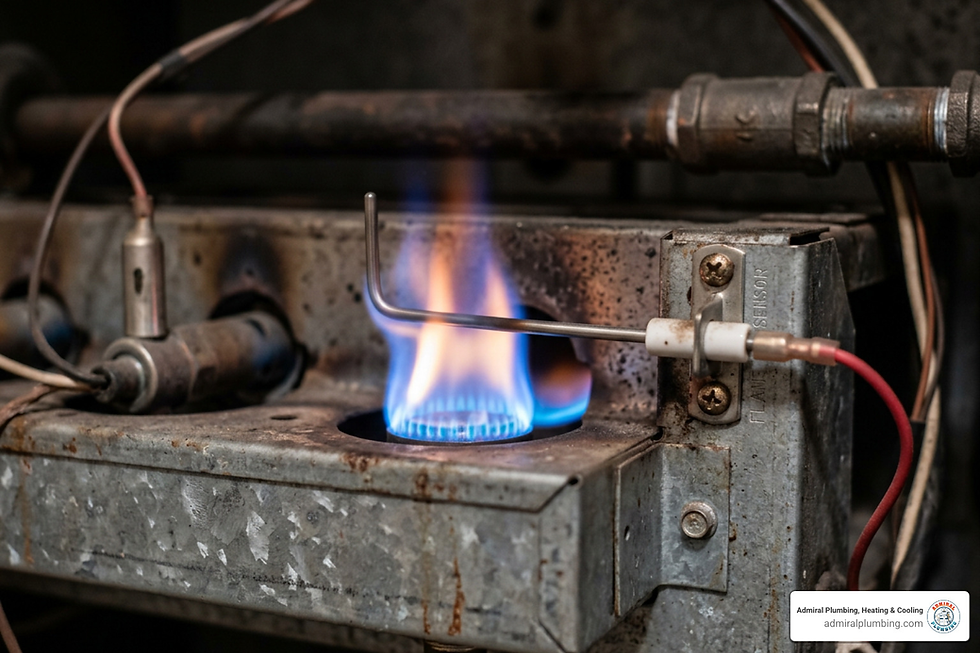
Before you can fix the sensor, you have to find it. In almost all Bryant gas furnaces (whether they are older mid-efficiency models or modern high-efficiency condensing units), the flame sensor is located inside the burner compartment.
To access it:
Turn off the electrical power switch on the side of your furnace (or shut off the breaker in your main panel).
Shut off the gas supply line valve leading to the furnace.
Remove the upper access door of the furnace cabinet.
Look at the burner assembly (the metal tubes where the flames shoot out).
Locate the hot surface igniter on one side of the burner box (usually the far left or far right).
Look at the opposite side of the burner box. Mounted there, you will see a small ceramic porcelain block with a single wire attached to a metal rod that bends directly into the path of the last burner's flame.
For a complete visual walkthrough and specific model diagrams, check out the Bryant Furnace Flame Sensor Location and Replacement Guide - Pick Comfort.
Other Issues That Mimic a Bad Bryant Furnace Flame Sensor
One of the biggest mistakes DIYers make is assuming that every short-cycling issue is a bad flame sensor. Several other safety switches can shut down your system and present almost identical symptoms.
If your furnace is acting up, we recommend checking our list of the Top 5 Common Furnace Problems and How to Fix Them to rule out other components. Here are the main culprits that mimic a flame sensor failure:
Pressure Switch Issues
The pressure switch ensures that the exhaust motor is successfully venting combustion gases outside. If there is a blocked chimney, a clogged condensate drain, or a split vacuum hose, the pressure switch will trip, cutting off the heating cycle.
High-Limit Switch Faults
This switch monitors the temperature inside the heat exchanger. If airflow is restricted—most commonly due to a severely clogged air filter—the heat exchanger will overheat, and the high-limit switch will shut the burners down. Airflow problems can reduce a heating and cooling system's efficiency by up to 15%.
Venting Blockages
Bird nests, ice, or debris blocking the outdoor PVC intake or exhaust pipes on high-efficiency furnaces will cause immediate safety shutdowns.
Control Board Grounding Issues
Flame rectification requires a solid electrical ground path through the burner metal back to the control board. If the furnace frame isn't properly grounded, or if the burner screws are heavily corroded, the microamp signal will drop to zero even if the sensor is pristine.
Step-by-Step Guide to Testing with a Multimeter
If you want to know with 100% certainty whether your bryant furnace flame sensor is the issue, you can test it using a digital multimeter that features a microamps ($\mu A$) setting.
Here is how to run the test safely:
Ensure the power to the furnace is turned off.
Locate the wire leading from the control board to the flame sensor terminal. Disconnect it at the quick-connect plug.
Set your digital multimeter to measure DC microamps ($\mu A$ DC).
Connect your meter in series: attach one meter lead to the wire coming from the control board, and the other lead to the metal terminal on the flame sensor itself. (The electrical current must flow through your meter for this to work).
Turn the furnace power back on and set your thermostat to call for heat.
Watch the meter as the burners ignite.
Interpret the results:
A healthy Bryant system should read between 1.5 and 4.0 microamps (ideally around 3.5 $\mu A$) and remain stable.
If the reading starts high and quickly drops below 1.0 $\mu A$, or stays below 1.0 $\mu A$ from the start, the sensor is dirty or failing.
If the reading is 0.0 $\mu A$ but the flame is clearly touching the rod, check your ground connections or test the control board voltage (which should supply ~95V AC to the rod before ignition).
If you do not feel comfortable handling live electrical testing with a multimeter, our certified team is always ready to help. You can easily schedule an expert diagnostic visit through our Furnace Inspection Services.
Choosing and Installing a Replacement Bryant Furnace Flame Sensor

If cleaning the sensor does not restore your microamp signal, or if you notice that the white porcelain insulator is cracked or the metal rod is severely pitted and bent, it is time to purchase a replacement.
When shopping, we highly recommend purchasing OEM (Original Equipment Manufacturer) parts rather than cheap, unbranded universal sensors. Bryant is a sister brand to Carrier, Payne, and Day & Night. Because of this, they share the exact same part numbers.
The two most common Bryant flame sensor part numbers are:
LH680012 (often used in older mid-efficiency systems)
LH680014 (standard on many modern condensing models)
While "universal" sensors are sold online, their metal rods are often slightly longer, shorter, or bent at different angles. If the rod does not sit directly in the hottest part of the burner flame, it will fail to generate a strong microamp signal, leaving you right back where you started.
For real-world discussions on finding the right part for older Bryant models, check out the Bryant Flame Sensor | DIY Home Improvement Forum.
DIY Replacement Steps for a Bryant Furnace Flame Sensor
Replacing a bryant furnace flame sensor is one of the most straightforward DIY furnace repairs you can perform.
Here is the step-by-step process:
Safety First: Flip the furnace power switch to "Off" and close the gas line valve.
Access the Burners: Remove the upper cabinet door of the furnace.
Disconnect the Wire: Gently pull the wire connector off the flame sensor spade terminal. If it is stuck, use a pair of needle-nose pliers to wiggle it free.
Remove the Mounting Screw: Use a 1/4-inch nut driver or socket wrench to remove the single sheet metal hex screw holding the sensor bracket to the burner box.
Remove the Old Sensor: Carefully slide the old sensor out of the burner box. Take note of its angle and orientation.
Install the New Sensor: Slide the new OEM sensor into the burner box opening. Ensure the metal rod is positioned directly in the path of where the burner flame will shoot.
Secure and Connect: Reinstall the 1/4-inch hex screw (do not over-tighten, as you could crack the porcelain). Slide the wire connector firmly back onto the spade terminal.
Test the System: Reinstall the cabinet door, turn on the gas valve, flip the power switch back on, and verify the furnace ignites and runs continuously.
If you encounter any unexpected issues during this process, or if the furnace still fails to stay lit, you can reach out to our team at Admiral Plumbing, Heating & Cooling for fast, professional assistance via our Furnace Repair Services.
Cost Comparison: DIY vs. Professional HVAC Service
How much can you expect to spend on a flame sensor issue? Here is a realistic breakdown of the costs for Northern Utah homeowners in 2026:
Service Option | Estimated Cost | What's Included? | Pros & Cons |
DIY Cleaning | $0 – $5 | Cost of a sheet of 600-grit emery cloth or steel wool. | Extremely cheap, but requires your time and basic comfort with tools. |
DIY Replacement | $10 – $50 | Cost of a brand-new OEM Bryant/Carrier replacement sensor rod. | Affordable, but you must accurately diagnose the issue and source the correct part. |
Professional Cleaning & Tune-Up | $80 – $150 | Complete safety check, burner cleaning, sensor polishing, and system test. | Safe, hands-off, and includes a full system health check to prevent future winter breakdowns. |
Professional Replacement | $150 – $300 | Diagnostic fee, brand-new OEM part, professional installation, and labor warranty. | Complete peace of mind, guaranteed safety, and zero hassle. |
While saving money with a DIY fix is great, many homeowners in Provo, Orem, and Salt Lake City prefer the safety assurance of professional service.
A certified technician will not only clean or replace the sensor, but will also perform a combustion analysis to ensure your furnace isn't leaking deadly carbon monoxide into your living spaces.
Frequently Asked Questions About Bryant Flame Sensors
What are the symptoms of a dirty Bryant furnace flame sensor?
The most common symptom of a dirty bryant furnace flame sensor is short cycling. Specifically, the furnace will start up, the igniter will glow, the gas will hiss and ignite into a blue flame, but the burners will shut off after exactly 5 to 7 seconds. The system will then blow cold air for a few minutes before trying to ignite again.
Additionally, modern Bryant furnaces will flash an Error Code 31 (three short flashes, one long flash on the yellow/red diagnostic LED light on the control board) to indicate a flame loss or ignition failure.
You may also notice a lazy, yellow flame instead of a crisp, bright blue flame, which indicates dirty burners that are depositing soot onto your sensor rod. For a deeper dive into diagnosing these signs, read the How to Tell If Flame Sensor is Bad - Furnace Repair and Troubleshooting Guide.
Can I clean a flame sensor with regular sandpaper?
No! You should never use standard black sandpaper or coarse sandpaper to clean a flame sensor. Regular sandpaper contains silica (quartz) crystals. When you rub the metal rod with sandpaper, it leaves behind microscopic silica dust.
When the furnace ignites, the intense heat of the flame melts this silica dust into a thin sheet of glass right on the metal rod. This glass coating acts as a perfect electrical insulator, permanently ruining the sensor.
Instead, always use 600-to-1000-grit emery cloth, a fine Scotch-Brite pad, or clean steel wool. Rub the rod very gently just until the bright, shiny metal is visible again, then wipe away any residual metal dust with a clean, dry paper towel before reinstalling it.
How often should a furnace flame sensor be serviced?
A furnace flame sensor should be inspected and cleaned at least once a year, ideally right before the cold Utah winter heating season begins.
Dust, pet hair, and airborne moisture naturally settle on the burner assembly during the dusty summer months when your AC is running. When the heating season starts, this debris burns off and leaves a carbon crust on the sensor rod.
Scheduling annual preventative maintenance is the best way to keep your heating system running at peak performance. You can book your annual pre-winter service through our Furnace Maintenance Services.
Conclusion
A dirty or failing bryant furnace flame sensor doesn't have to leave you freezing in the middle of a cold Northern Utah winter.
Whether you choose to take on this repair as a quick weekend DIY project or prefer the guaranteed safety of professional service, addressing the issue promptly will protect your furnace and keep your home comfortable.
At Admiral Plumbing, Heating & Cooling, we have been keeping homes warm and safe across Provo, Orem, and the surrounding Northern Utah areas for years. We hold an A+ rating with the Better Business Bureau and are proud to offer 24/7 emergency heating services when you need us most.


Comments