
How to Hire Commercial Plumbing Contractors Without Getting Drained

Updated: 4 days ago
Why Hiring the Right Commercial Plumbing Contractors Can Make or Break Your Business

Commercial plumbing contractors are licensed professionals who install, repair, and maintain the large-scale plumbing systems found in businesses, industrial facilities, and multi-unit buildings.
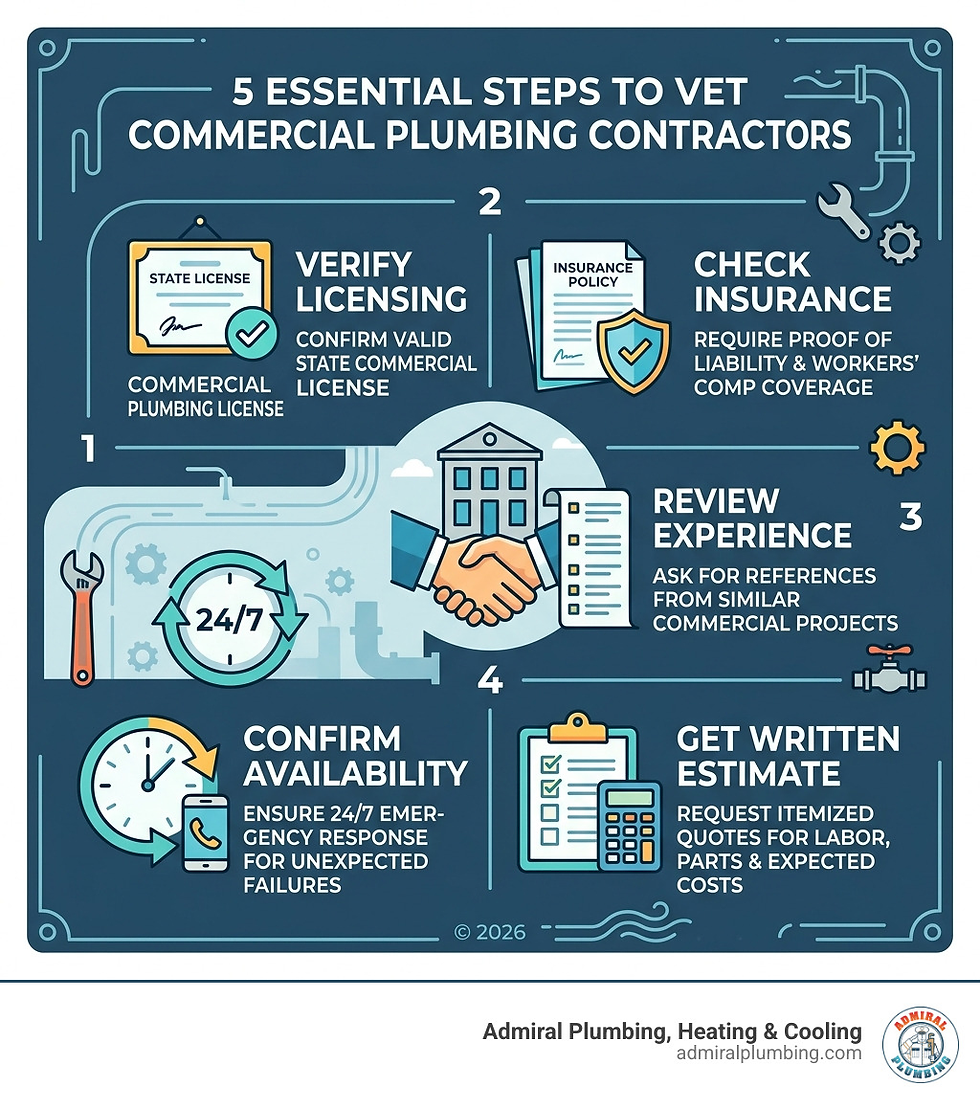
Here's a quick look at how to hire the right one:
Verify licensing - Confirm the contractor holds a valid state commercial plumbing license
Check insurance - Require proof of liability and workers' compensation coverage
Review experience - Ask for references from similar commercial buildings or industries
Confirm 24/7 availability - Plumbing failures don't wait for business hours
Get a written estimate - Itemized quotes covering labor, parts, and expected costs protect you
Check reviews - 85% of consumers choose services with positive reviews, while 77% avoid companies with negative feedback
When a drain backs up mid-lunch rush at a restaurant, or a pipe bursts in a hotel at 2 a.m., the stakes are completely different from a leaky faucet at home. A plumbing failure in a commercial setting doesn't just cause inconvenience — it threatens revenue, operations, and your customers' safety.
Commercial plumbing systems are bigger, more complex, and held to stricter codes than anything you'd find in a house. That means the contractor you hire needs to be more than just handy with a wrench.
This guide walks you through exactly what to look for — so you don't get drained in the process.
Understanding the Scope of Commercial Plumbing Contractors
As we move into April 2026, the landscape of facility management is shifting toward smarter, more integrated systems. However, the fundamentals of heavy-duty plumbing remain the backbone of any successful operation.
Commercial plumbing contractors specialize in systems that are vastly different from residential setups. While a home might support four or five people, a commercial system may need to support hundreds or thousands of users simultaneously.

When you invest in Commercial Plumbing Installation, you aren't just putting in pipes; you are building an infrastructure designed for high-volume demand.
These systems utilize heavy-duty fixtures, industrial-grade water heaters (sometimes 100 gallons or more), and complex piping networks that often run through concrete slabs or multiple stories of a high-rise.
Eventually, every system reaches its limit. Whether it's due to age or a shift in business needs, Commercial Plumbing Replacement becomes necessary. This isn't a simple "swap and go" job.
It requires a contractor who understands how to replace massive sewer lines or boiler systems without shutting down your entire operation for weeks.
Residential vs. Commercial Plumbing: A Comparison
Feature | Residential Plumbing | Commercial Plumbing |
Usage Volume | Low/Intermittent | High/Constant |
System Complexity | Simple, standard layouts | Complex, multi-story, high-pressure |
Pipe Size | Typically 0.5" to 2" | Often 6" main lines or larger |
Fixtures | Standard toilets, sinks, showers | Industrial urinals, sensor faucets, grease traps |
Code Requirements | Standard building codes | Strict health, safety, and ADA regulations |
Specialized Services for Commercial Plumbing Contractors
A true commercial expert offers more than just leak repairs. They manage the "guts" of your facility that the public never sees but relies on every day.
Backflow Testing: This is a state-mandated annual requirement. Without it, municipalities can shut off your water supply. It ensures that contaminated water doesn't flow backward into the clean city water lines.
Grease Traps: Essential for restaurants and food service, these prevent Fats, Oils, and Grease (FOG) from clogging the city sewer and incurring massive fines.
Lift Stations and Sewage Ejectors: In buildings where plumbing fixtures are located below the main sewer line level, these pumps do the heavy lifting to move waste out of the building.
Booster Pumps: In high-rise buildings, these systems ensure that water pressure remains consistent on the 10th floor just as it is on the 1st.
Medical Gas Piping: For our healthcare clients, specialized piping is required to deliver oxygen and other gases safely to patient rooms.
Handling New Construction and Renovations
Whether you are breaking ground on a new retail center in Provo or renovating an existing office space, the plumbing phase is critical. Qualified commercial plumbing contractors provide comprehensive Commercial Plumbing Services that begin long before a pipe is glued.
This includes blueprint reading and design-build capabilities. A contractor must be able to look at a shell and core plan and coordinate with other trades—like electrical and HVAC—to ensure everything fits.
They handle the state plan submittals and ensure that every inch of the installation is code-compliant, preventing costly delays during the inspection phase.
Essential Qualifications and Vetting Strategies
In commercial service, "good enough" usually isn't. When you are vetting a contractor, you need to look for a level of professionalism that matches the scale of your business.

Start with a Commercial Plumbing Inspection. A reputable contractor will offer to walk your facility and identify potential "ticking time bombs" before they become emergencies. During this process, you should be evaluating their credentials.
State Licensing: In Utah, commercial work requires specific licensure through the Utah Division of Professional Licensing (DOPL) that differs from residential-only permits.
Liability Insurance: Never hire a contractor who cannot provide a current certificate of insurance. If a pipe bursts and floods your warehouse, their insurance should cover the damage, not yours.
BBB Ratings: Look for an A+ rating with the Better Business Bureau. It’s a sign of long-term reliability and a commitment to resolving customer issues.
The 85% Rule: Statistics show that 85% of consumers choose services based on positive reviews. However, don't just look at the stars—look at how the company responds to the 77% of consumers who avoid companies with negative feedback. A professional response to a complaint says a lot about their integrity.
Why Licensing Matters for Commercial Plumbing Contractors
Licensing is your primary protection against subpar work. A licensed contractor is bound by municipal regulations and code compliance. If they perform work that isn't up to code, they risk their license. This is especially important for Commercial Plumbing where health department sign-offs are often required.
Specifically, look for contractors who employ state-certified inspectors for annual RPZ (Reduced Pressure Zone) testing. If this backflow prevention device fails or isn't tested, your local municipality has the authority to shut off your water supply to protect the public.
Evaluating Experience and References
Ask potential contractors about their specific experience with your building type. A plumber who excels at fixing residential toilets might be completely lost when faced with the retail portfolios of a shopping mall or the sterile environment requirements of healthcare facility expertise.
Don't be afraid to ask for written estimates and contact information for current clients. A contractor who has successfully managed local industrial sites for years will be happy to share their success stories.
Evaluating Service Models, Costs, and Response Times
Time is money in the business world. If your facility is down, you are losing profit. That’s why 24/7 availability isn't just a perk; it’s a necessity.
When a pipe fails at 3:00 AM on a Sunday, you need a contractor with rapid response protocols. We pride ourselves on being there when it matters most, ensuring that your Commercial Plumbing Repair is handled quickly enough to keep your doors open for Monday morning business.
Pricing Models for Commercial Plumbing Contractors
Commercial pricing is generally higher than residential due to the specialized equipment and higher insurance premiums required. Here is what you can typically expect in the current 2026 market:
Service Call Fees: Most reputable contractors charge a minimum fee ranging from $50 to $200 just to get a truck to your door.
Hourly Rates: For labor, expect to pay between $100 and $200 per hour per technician. Large-scale repairs or specialized welding might be higher.
Transparent Pricing: Avoid "estimates" that are scribbled on a napkin. You want a professional bidding process that itemizes labor and equipment costs.
Budget Accommodation: A good contractor will work with you to prioritize repairs, helping you manage your facility budget without sacrificing safety.
Maximizing ROI with Preventative Maintenance Agreements
The most expensive plumbing repair is the one you didn't see coming. This is where Commercial Plumbing Maintenance pays for itself.
By scheduling regular Commercial Plumbing Tune-Ups, you can catch small leaks, scaling in water heaters, or slowing drains before they cause a total shutdown.
Benefits of a Maintenance Agreement include:
Avoiding Downtime: Scheduled service happens on your time, not during your peak hours.
System Longevity: Well-maintained pumps and boilers last years longer than neglected ones.
Seasonal Winterization: In Northern Utah, freezing pipes are a major threat. Proper winterization protects your outdoor lines and unheated warehouse spaces.
Priority Service: Maintenance clients often jump to the front of the line when an emergency does occur.
Frequently Asked Questions about Commercial Plumbing
What types of businesses and facilities do you serve?
We provide comprehensive services to a wide range of Northern Utah industries, including:
Restaurants and Commercial Kitchens (Grease trap and drain focus)
Hotels and Hospitality (Hot water and high-capacity system focus)
Healthcare and Medical Offices (Sanitation and medical gas focus)
Retail Centers and Malls (Public restroom and multi-tenant focus)
Industrial Plants and Warehouses (Process piping and heavy-duty waste focus)
Multi-Family Housing (Apartments and condos)
Data Centers (Specialized cooling and drainage)
What are the key questions to ask potential contractors?
Before signing a contract, ask these five questions:
Can you provide your license number and proof of insurance right now?
What is your average response time for a 2 a.m. emergency?
Have you worked in a facility like mine (e.g., a hospital or a restaurant) in the last six months?
Can you provide three references from local businesses?
Do you offer itemized, written estimates before the work begins?
Why is backflow testing and grease trap maintenance essential?
These aren't just "good ideas"—they are often legal requirements. Backflow testing prevents the cross-contamination of your building's water with the municipal supply. Grease trap maintenance is essential for FOG regulation adherence.
If grease enters the main city lines, it can cause massive sewer backups, leading to environmental fines and the potential for the city to shut down your operations entirely.
Conclusion
Hiring the right commercial plumbing contractors is an investment in your business's future. You need a partner who understands that in the commercial world, a leak is more than just water—it’s lost time and lost money.
At Admiral Plumbing, Heating & Cooling, we’ve spent years building our reputation as Northern Utah's trusted choice for business owners. With our A+ BBB rating and 24/7 emergency response, we are always ready to keep your facility running smoothly.
Whether you need a simple repair or a massive new installation, we bring the expertise and the heavy-duty tools required for the job.


Comments