
Swamp Cooler Energy Efficiency vs AC: Which Wins?

Updated: Jul 31
Swamp Cooler Energy Efficiency vs. AC: The Quick Answer

Swamp cooler energy efficiency is one of the biggest advantages this technology offers — and the numbers are hard to ignore.
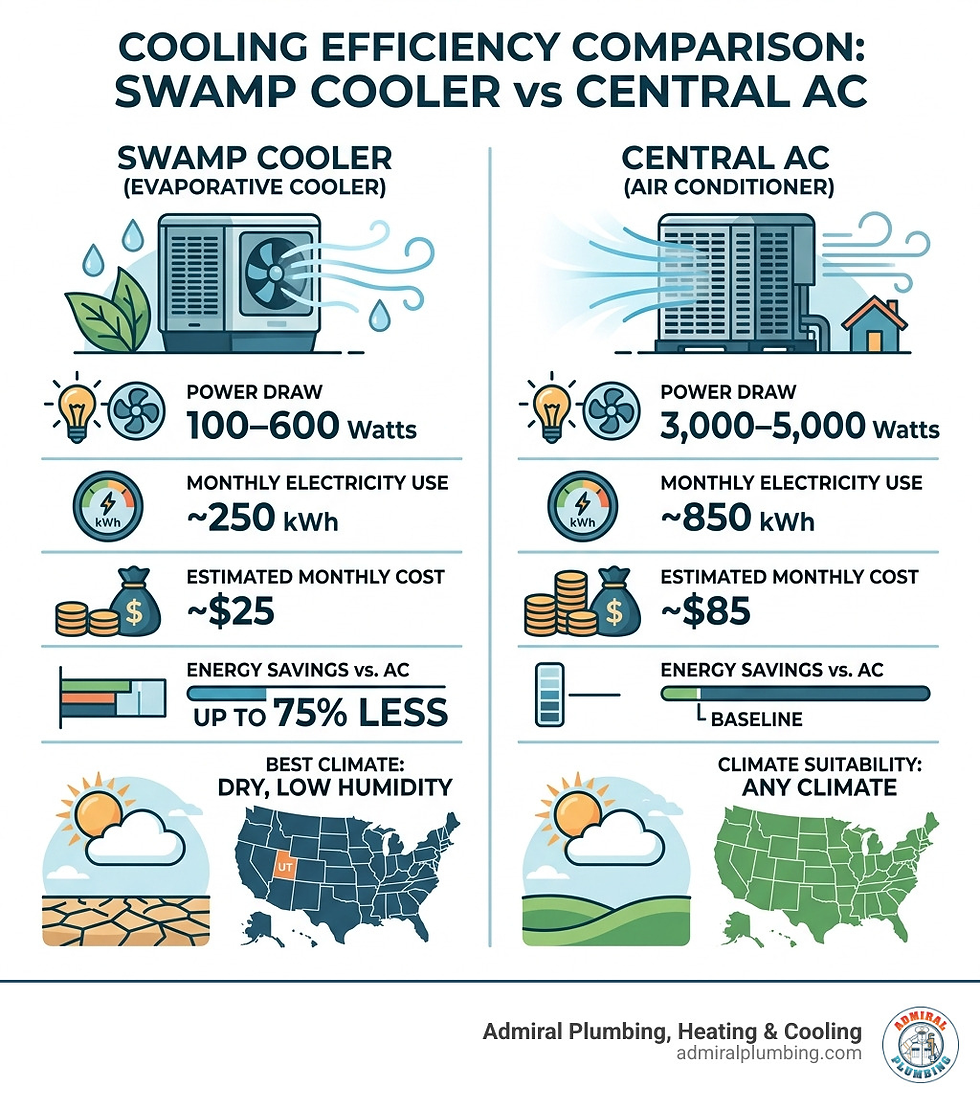
Quick comparison for Utah County homeowners:
Swamp Cooler | Central AC | |
Power draw | 100–600 watts | 3,000–5,000 watts |
Monthly electricity use | ~250 kWh | ~850 kWh |
Estimated monthly cost | ~$25 | ~$85 |
Energy savings vs. AC | Up to 75% less | Baseline |
Best climate | Dry, low humidity | Any climate |
Every summer, Utah County homeowners face the same decision: crank up the AC and watch the electric bill spike, or find a smarter way to stay cool.
Swamp coolers — also called evaporative coolers — use a fraction of the electricity that traditional air conditioners do. In the right climate, they can cut your cooling costs by up to 75%. For a typical home in Northern Utah, that difference can add up to hundreds of dollars over a single summer.
But they're not the right choice for every situation. The dry air around Utah Lake is actually ideal for evaporative cooling — but as summers get hotter and longer, knowing when a swamp cooler wins and when AC takes over matters more than ever.
This guide breaks it all down so you can make the right call for your home and your budget.
How Evaporative Cooling Works
To understand why swamp cooler energy efficiency is so high, we have to look at the physics behind the machine. While a traditional air conditioner relies on a power-hungry compressor and chemical refrigerants to "create" cold, a swamp cooler uses a natural process that has been around since ancient times.
Evaporative cooler technology is based on the principle of "enthalpy of vaporization." In simpler terms: when water evaporates, it absorbs heat from the air. Think about how you feel a chill when you step out of a swimming pool on a breezy day. That is evaporative cooling in action.
The system consists of three main parts: a water reservoir, thick cooling pads, and a blower fan. A pump keeps the pads saturated with water. The fan pulls hot, dry outdoor air through these wet pads.
As the air passes through, the water evaporates, converting "sensible heat" (the temperature you feel) into "latent heat." This process can drop the air temperature by 15°F to 40°F before it is blown into your home.
Unlike AC, which recirculates the same stale indoor air, a Swamp Cooler provides a constant fresh air exchange. It pushes old air out through slightly opened windows, ensuring your home doesn't just feel cooler, but fresher too.
Swamp Cooler Energy Efficiency vs. Traditional AC
When we talk about "efficiency," we are really talking about how much cooling you get for every dollar spent on electricity. In Northern Utah, the gap between these two systems is massive.
Research shows that evaporative coolers use about one-quarter as much energy as central air conditioners. While a typical central AC unit might pull between 3,000 and 5,000 watts per hour, most residential swamp cooler models operate on just 100 to 600 watts.
According to the Department of Energy, this results in a reduction of energy consumption by up to 75% compared to traditional refrigerated systems.
In a real-world setting, like a 2,000-square-foot home in the Southwest, an AC unit might consume 850 kWh per month, leading to a bill of roughly $85. In contrast, a swamp cooler doing the same job would use only 250 kWh, costing about $25.
This makes them highly effective in both residential and commercial settings where large open spaces—like garages or warehouses—need to be cooled without breaking the bank.
Feature | Swamp Cooler | Traditional AC |
Wattage | 100 - 600W | 3,000 - 5,000W |
Cooling Method | Water Evaporation | Vapor Compression |
Air Quality | Fresh Outdoor Air | Recirculated Air |
Installation Cost | ~$500 - $2,500 | ~$5,000 - $12,000+ |
For more details on how these systems stack up in different environments, check out this guide on Are Swamp Coolers Energy Efficient in Different Settings?
Innovations in Swamp Cooler Energy Efficiency
The technology has come a long way since the "dinosaurs" of the 1970s. Modern innovations are pushing the limits of swamp cooler energy efficiency even further.
One of the most exciting developments is the Two-Stage Evaporative Cooler. These units use a pre-cooler (often an indirect heat exchanger) to lower the air temperature without adding moisture first. Then, the air passes through a second stage of standard evaporative cooling.
This allows the system to reach much lower temperatures—approaching the "dew point" rather than just the wet-bulb temperature—without making the indoor air feel overly humid.
Additionally, the use of variable-speed motors and high-performance rigid media pads (instead of old-fashioned aspen wood) has optimized airflow and evaporation rates. If you are considering an upgrade, a professional Swamp Cooler Installation can ensure you have the most modern, efficient unit for your specific square footage.
How Maintenance Impacts Swamp Cooler Energy Efficiency
You wouldn't expect a car to get good gas mileage if the air filter was clogged and the engine was low on oil. The same applies to your cooling system. Maintenance is the single most important factor in maintaining long-term swamp cooler energy efficiency.
Mineral buildup (scaling) is the "efficiency killer" for swamp coolers in Northern Utah. Our water can be hard, and as water evaporates, it leaves behind calcium and magnesium deposits on the pads.
When pads become "calcified," they can't hold water effectively, and airflow is restricted. This forces the motor to work harder while providing less cooling.
We recommend:
Monthly Pad Checks: In hot months, check for sediment and scaling.
Seasonal Cleaning: Drain the reservoir to remove "swampy" sediment that can clog the pump.
Belt Tension: Ensure the fan belt isn't slipping, which wastes energy.
Regular Swamp Cooler Maintenance and professional Swamp Cooler Tune Ups can extend the life of your unit to over 25 years while keeping your utility bills at their absolute lowest.
The Water-Energy Nexus: Efficiency Beyond Electricity
When discussing the efficiency of a swamp cooler, we have to talk about water. It is the "fuel" that makes the system work. A typical residential unit uses between 3 and 15 gallons of water per hour. While this sounds like a lot, it’s important to look at the "Water-Energy Nexus."
Producing electricity requires a massive amount of water at the power plant (for cooling and steam generation). Because a Swamp Cooler Repair keeps your unit running efficiently and using less power, you are actually reducing the indirect water use at the power plant.
In many cases, the total water footprint of a swamp cooler is actually lower than that of a traditional AC unit when you factor in the water used to generate those extra 600+ kWh of electricity.
Furthermore, many homeowners in Provo and surrounding areas are finding ways to repurpose the "bleed-off" water (the small amount of water drained to prevent mineral buildup) for landscaping or rock beds, making the system even more eco-friendly.

Ideal Climates and the Impact of Climate Change
The golden rule of evaporative cooling is simple: the drier the air, the better it works. In Northern Utah, we are blessed with low humidity, which allows swamp coolers to achieve that impressive 15°F to 40°F temperature drop.
However, we have to address the elephant in the room: climate change. As we move through May 2026, we are seeing "urban heat islands" and slightly rising humidity levels in some Southwest regions.
When the outdoor humidity exceeds 60%, the air is already too saturated to "take on" more water vapor, and the cooling effect stops.
In these rare "monsoon" moments or during extreme 100°F+ heat spikes, traditional AC becomes superior because it dehumidifies the air while cooling it. This is why some residents choose a Swamp Cooler Replacement to upgrade to a high-efficiency heat pump or a hybrid system that offers the best of both worlds.
For a deeper dive into how these units handle extreme heat, see the Do Evaporative Coolers Work? 2026 Guide.
Pros and Cons of Evaporative Cooling Systems
Is a swamp cooler right for you? Let's weigh the benefits against the drawbacks.
The Pros:
Energy Savings: As mentioned, they use up to 75% less electricity.
Fresh Air: They provide a constant stream of fresh, filtered outdoor air, which reduces CO2 levels and indoor pollutants.
Eco-Friendly: No chemical refrigerants (CFCs or HFCs) that contribute to ozone depletion.
Cost: They are about half the price to install compared to central AC.
The Cons:
Maintenance: They require more frequent attention (cleaning pads and reservoirs) than an AC unit.
Humidity: They add moisture to the air. While great for dry skin and sinuses, it can make the house feel "sticky" if not vented properly.
Water Use: They require a constant water supply and may be restricted during extreme droughts.
To ensure your system isn't hiding any issues like mold or pump wear, a professional Swamp Cooler Inspection is a smart move every spring.
Frequently Asked Questions about Swamp Coolers
Is a swamp cooler more efficient than a portable AC?
Yes, by a significant margin. A portable AC unit usually plugs into a standard outlet but can use 1,000 to 1,500 watts. A swamp cooler of similar cooling capacity uses only 100 to 600 watts.
Additionally, portable AC units often struggle with efficiency because they create negative pressure, pulling warm air back into the room through gaps in doors and windows.
At what humidity level does a swamp cooler stop working?
The "magic number" is generally 60% relative humidity. Once the air hits this saturation point, evaporation slows down significantly. In Northern Utah, our humidity is usually much lower (often 10-30% in the afternoon), which is why swamp cooler energy efficiency remains so high here.
If the wet-bulb temperature is too high, the air simply can't hold more moisture to create a cooling effect.
Can I run my swamp cooler 24/7 to save money?
Technically, yes. Because the operational costs are so low (roughly $0.20 to $0.40 per hour), running it 24/7 won't "break the bank" like an AC unit would. However, running it non-stop can accelerate wear and tear on the pump and motor.
We usually recommend running it on "vent only" at night when the outdoor air is cool, which saves even more water and electricity.
Conclusion
When it comes to swamp cooler energy efficiency, the evidence is clear: for homeowners in Northern Utah, these systems offer a powerful way to stay comfortable while keeping utility costs low. By utilizing the natural power of evaporation, you can enjoy a fresh, cool home for a fraction of the price of traditional air conditioning.
At Admiral Plumbing, Heating & Cooling, we’ve been serving the Provo area and surrounding Northern Utah communities with pride. Whether you need a 24/7 emergency repair, a brand-new installation, or a seasonal tune-up, our A+ BBB-rated team is here to help.
We understand the unique climate around Utah Lake and can help you decide if a swamp cooler or a high-efficiency AC is the best fit for your family's needs.


Comments