
Compare AC Installation Costs: A Detailed Guide to Pricing & Options

Updated: Nov 1
AC Installation Costs Start With the Right System

The best way to compare AC installation costs is to get written quotes for a system sized to your home. A window unit usually has the simplest setup. A ductless mini-split can cool rooms without ducts, while central air can cool the whole home through ductwork.
The installed price depends on the system, cooling capacity, duct condition, electrical work, and labor. Ask each contractor to include those items in the quote so you can compare more than the equipment price.
I'm Adam Wettach, owner of Admiral Plumbing, Heating & Cooling. My hands-on experience with residential trade work has taught me why clear estimates and careful planning matter when homeowners weigh AC installation options.

According to data from the U.S. Department of Energy, heating and cooling account for roughly 48 percent of energy use in a typical American home. Because cooling takes up such a substantial portion of your annual utility expenses, choosing the right equipment and ensuring it is set up correctly makes a massive difference to your wallet.
Studies show that an improper setup can reduce total operating efficiency by up to 30 percent, turning what should have been an energy-saving upgrade into an expensive monthly headache. Understanding your equipment options, sizing requirements, and the true variables behind labor and materials will help you make a confident decision for your home.
Comparing Cooling Systems: Mini-Splits and Central Air
When evaluating whole-home cooling, most homeowners compare two primary split systems: ductless mini-split heat pumps and traditional central air conditioners. Both rely on an outdoor compressor/condenser unit paired with indoor cooling components, but they deliver conditioned air through completely different distribution methods.
Feature / Metric | Ductless Mini-Split Systems | Traditional Central Air Conditioning |
Ductwork Required | No (uses small refrigerant lines) | Yes (requires supply and return duct networks) |
Cooling Coverage | Multi-zone or single-room targeting | Whole-home unified temperature control |
Average Lifespan | 15 to 20 years | 15 to 20 years (with regular maintenance) |
Efficiency Range (SEER2) | Often 18 to 25+ SEER2 | Typically 14 to 22+ SEER2 |
Installation Complexity | Low-to-moderate architectural disruption | Moderate-to-high (high if retrofitting ducts) |
Ideal Application | Homes without ducts, additions, targeted zones | Homes with existing, well-sealed duct systems |
Ductless Mini-Split Heat Pumps
Ductless mini-splits consist of an outdoor condenser connected to one or more indoor air handlers via a small conduit housing the refrigerant line, power cable, and condensate drain. These wall cassettes, floor units, or ceiling-suspended handlers give you precise room-by-room zoning flexibility.

Because they bypass ductwork completely, mini-splits eliminate the air leakage that plagues traditional setups. If your home lacks central ductwork or has rooms that run consistently hot, investing in a professional ductless system installation provides efficient heating and cooling without requiring wall demolition or soffit construction.
Central Air Conditioning Systems
Traditional central cooling systems use an outdoor condenser paired with an indoor evaporator coil, usually mounted on your furnace or dedicated air handler. Conditioned air moves through a centralized network of supply registers and returns.
Central systems remain the gold standard for uniform, whole-home temperature management when solid ductwork is already in place. Modern split systems operate quietly and integrate seamlessly with whole-house filtration, air purifiers, and central humidifiers. When your current air handler is ready for an upgrade, arranging a comprehensive central air installation ensures balanced airflow across every living area.
Factors That Influence Overall AC Installation Costs
The total price of setting up a new cooling system involves far more than just purchasing a piece of metal machinery. Multiple structural, logistical, and environmental variables shape final estimates.

System Efficiency and SEER2 Ratings
Cooling efficiency is measured using the Seasonal Energy Efficiency Ratio 2 (SEER2). The federal minimum SEER2 standard for northern climate zones sits at 14, while premium high-efficiency units reach ratings between 16 and 25.
While higher SEER2 systems carry a higher upfront cost, they drastically slash monthly utility bills and often qualify for utility rebates. If you are scheduling a new residential air conditioning installation, we calculate the payback window between mid-tier and ultra-high-efficiency systems to help you find the financial sweet spot for your budget.
Ductwork Integrity and Layout Modifications
A central air conditioner relies entirely on the ducts that carry its air. Industry data indicates that a typical duct system loses 20 to 30 percent of conditioned air through loose seams, disconnected joints, and uninsulated passages.
If your existing sheet metal is undersized or leaking, your new unit will work harder, run longer, and drive up electric bills. Before installing new machinery, completing necessary ductwork repair or sealing distribution plenums ensures your cooling system delivers its full rated capacity straight into your living spaces.
Electrical Upgrades and Smart Thermostat Integration
Modern high-performance cooling equipment requires reliable electrical service. Technicians must inspect your service panel to ensure it can support the dedicated double-pole circuit breaker and outdoor disconnect switch your new equipment requires.
Pairing your new setup with modern smart thermostats allows for custom scheduling, remote temperature management, and automated setback features that prevent energy waste when nobody is home.
Sizing Your Unit: The Science Behind Proper Cooling
Selecting an air conditioner is not like buying a television, where bigger is almost always assumed to be better. Sizing an AC unit requires a careful engineering assessment of the exact heat load entering your living space.

Central AC Installation Sizing and Load Calculations
To determine the ideal cooling capacity—measured in British Thermal Units (BTUs) or tons (where 1 ton equals 12,000 BTUs per hour)—licensed HVAC professionals perform a Manual J load calculation. This diagnostic process evaluates:
Total finished square footage and ceiling height
Wall and attic insulation values
Window sizes, orientations, and low-E glass coatings
Local climate norms, altitude, and summer solar gain
Heat generated by home occupants, lighting, and appliances
Proper load calculations adhere strictly to the engineering parameters laid out in each manufacturer installation manual to ensure the physical machinery matches the architectural reality of your property.
Risks of Undersized and Oversized Systems
Installing the incorrect system capacity creates serious comfort and performance issues:
Undersized Systems: A unit that lacks adequate cooling capacity will run continuously on hot summer afternoons without ever reaching the setpoint on your thermostat. This constant running drives up energy bills and burns out internal electrical components prematurely.
Oversized Systems: An oversized unit cools the indoor air too quickly and shuts down before completing a full cooling cycle. This behavior, known as short-cycling, leaves air clammy and humid because an air conditioner needs sustained runtime to remove moisture. Short-cycling also places intense mechanical stress on the compressor and fan motors.
Professional Installation Process: Step-by-Step Timeline and Expectations
Professional HVAC projects require careful logistical coordination, technical expertise, and adherence to environmental and electrical safety codes.

(Shown below as our standard quality-assurance process)
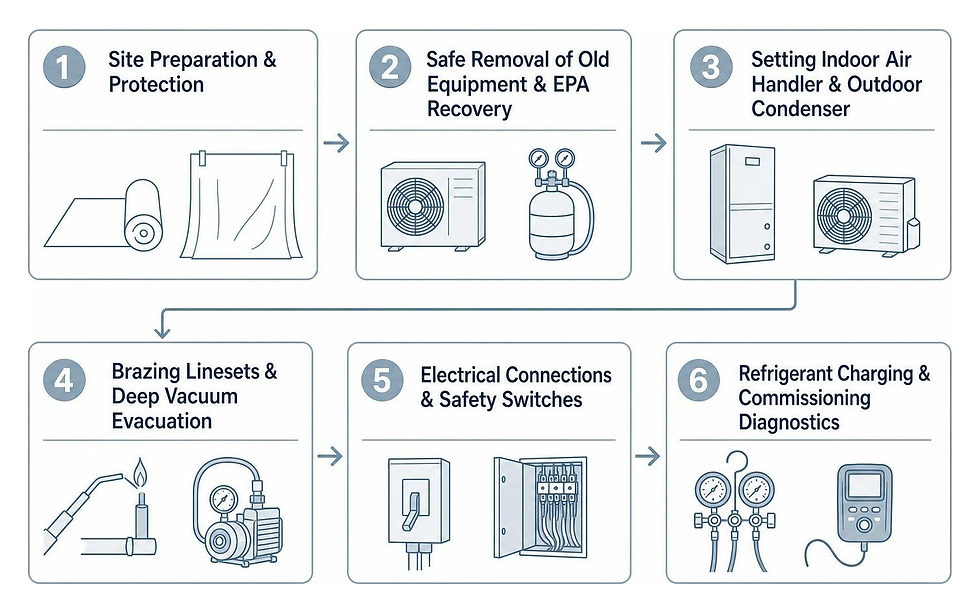
Preparing Your Home for AC Installation Day
You can help the installation go smoothly by preparing your home before our service crews arrive:
Clear Work Pathways: Provide a clear path from the driveway to your indoor mechanical closet, basement, or attic access point.
Clear the Outdoor Pad Location: Move patio furniture, garden hoses, and children's toys away from the outdoor condenser site, maintaining at least 18 to 24 inches of clear space around the perimeter.
Secure Pets: Keep dogs and cats in a quiet, closed room to protect them from open doors and moving equipment.
Ensure Electrical Access: Make sure our technicians have unobstructed access to your main electrical panel.
Removal, Refrigerant Charging, and System Startup
Our installation team follows a strict, step-by-step commissioning protocol:
Equipment Removal & Refrigerant Recovery: Technicians safely recover existing refrigerant in compliance with EPA environmental regulations before removing old equipment.
Mounting & Pad Placement: We install a level, composite pad outdoors to protect the condenser from ground moisture and vibration, and secure the indoor evaporator coil.
Refrigerant Line Brazing & Evacuation: Technicians braze copper linesets using nitrogen purges, followed by pulling a deep vacuum below 500 microns to remove all moisture and non-condensable gases from the closed loop.
Precision Charging & Testing: The system is charged with exact factory-specified refrigerant levels. We check static air pressures, measure the temperature drop across the coil, and calibrate the thermostat to ensure peak efficiency.
Signs It Is Time for a Replacement vs. Repair
Knowing whether to invest in another repair or schedule an equipment upgrade helps you avoid sinking money into an old, inefficient machine.
The 50% Rule and Equipment Age Thresholds
Most residential air conditioning systems have an expected operating lifespan of 10 to 15 years, though a well-maintained split system can reach 15 to 20 years.
A reliable guideline in our industry is the 50% Rule: if your equipment is over 10 years old and an unexpected repair estimate approaches 50 percent of the value of a replacement system, upgrading is almost always the smarter financial choice.
If your compressor fails, the system uses phased-out refrigerants, or your utility costs continue climbing despite routine service calls, choosing an energy-efficient air conditioning replacement will lower your monthly operating expenses and restore dependable comfort.
Post-Installation Maintenance Checklist
To protect your investment and maintain factory warranty coverage, establish a consistent routine after your new unit is operational:
Replace Air Filters Regularly: Check your furnace or air handler filter every 30 to 90 days. A clogged filter chokes airflow, reduces efficiency, and can freeze your indoor evaporator coil.
Keep Outdoor Coils Clear: Clear leaves, grass clippings, and weeds away from the outdoor compressor cabinet.
Inspect the Condensate Line: Check the condensate drain line periodically to ensure water drains freely away from your foundation.
Schedule Annual Service: Book regular annual AC maintenance every spring. Our technicians will clean the coils, verify electrical connections, lubricate moving parts, and balance refrigerant levels.
Frequently Asked Questions About AC Installation
How long does a typical air conditioning installation take?
A straightforward residential replacement—where our technicians replace an existing condenser and indoor coil connected to sound ductwork—is usually completed in a single day, typically taking between 4 and 8 hours.
If your home requires extensive sheet metal work, structural modifications, or a full ductless multi-zone retrofit, the installation can take 2 to 3 days. We provide a clear project schedule before beginning any work.
Is a mechanical permit required for installing a new cooling system?
Yes. Most local municipalities require a mechanical and electrical permit for central cooling and heat pump installations.
Permitting protects homeowners by requiring third-party safety inspections to verify that all high-voltage electrical work, structural mountings, and refrigerant safety standards comply with local building codes. As licensed HVAC contractors, we pull all necessary permits and handle the final inspection scheduling directly.
What should I look for when hiring an HVAC contractor?
When selecting an HVAC installer, always confirm:
Full state licensing, bonding, and comprehensive general liability insurance
Technicians certified by industry bodies such as NATE (North American Technician Excellence)
Transparent, written, itemized estimates that clearly outline equipment models, labor scope, and warranty terms
Verified customer reviews and an A+ Better Business Bureau rating
The availability of 24/7 emergency air conditioning services to support your system long after installation day
Conclusion
Upgrading your home's air conditioner is an investment in your family's daily comfort, indoor air quality, and long-term energy savings. By pairing properly sized equipment with an airtight duct distribution system, you can eliminate warm rooms, maintain healthy humidity levels, and keep your utility costs manageable for years to come.
At Admiral Plumbing, Heating & Cooling, we take pride in delivering honest recommendations, upfront pricing, and expert craftsmanship on every job.


Comments