
How to Choose a CCTV Pipe Inspection Camera Without Going Down the Drain

Updated: 4 hours ago
Why a CCTV Pipe Inspection Camera Matters

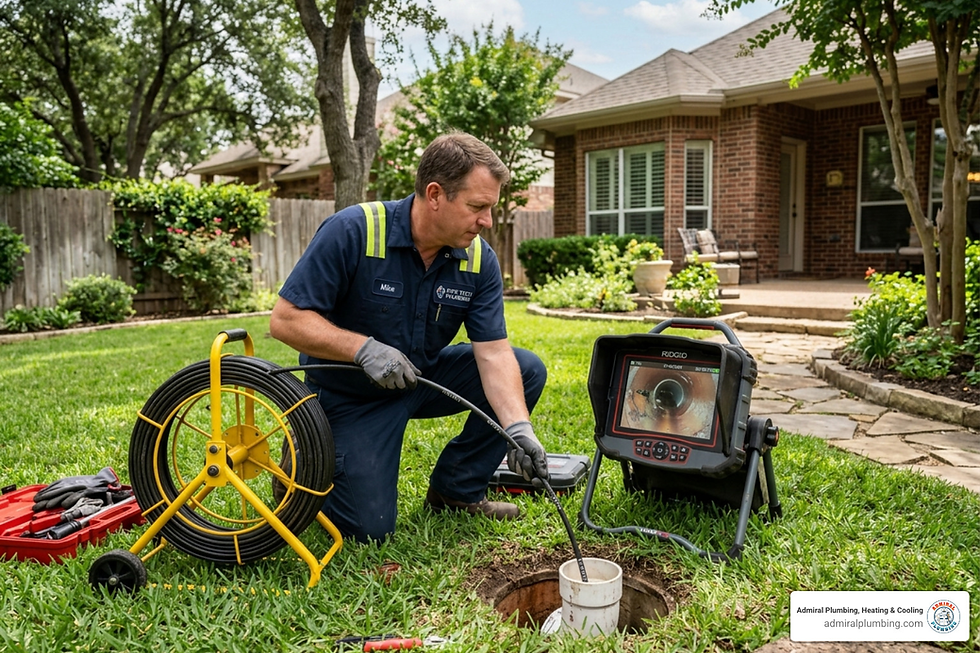
A cctv pipe inspection camera is a waterproof camera on a flexible cable or motorized crawler that sends live video from inside a drain or sewer line to a monitor. It helps a plumber find cracks, root intrusion, blockages, offset joints, and pipe damage without digging up your yard or guessing at the cause.
For a homeowner dealing with slow drains, repeat clogs, or a possible sewer leak, this means a faster diagnosis and a more targeted repair plan. Modern systems can record HD video, use LED lights in dark pipes, and often include a locating transmitter to mark the problem's position from above ground.
I am Adam Wettach, owner of Admiral Plumbing, Heating & Cooling, and I have hands-on experience diagnosing residential and commercial drain problems with a cctv pipe inspection camera.
In this guide, I will explain what these systems do, what features matter, and when a camera inspection can save you from a larger repair.

What Is a CCTV Pipe Inspection Camera and How Does It Work?
At its core, a cctv pipe inspection camera is a remote visual inspection tool engineered to navigate pitch-black, fluid-filled subterranean pipelines.
Before closed-circuit television (CCTV) inspection technology became widely accessible, finding a broken drain pipe involved destructive open-trench excavation. Contractors had to dig up entire lawns or tear up concrete slabs just to locate a single obstruction.

Today, video pipe inspection relies on non-invasive visual technology. A waterproof camera unit is inserted directly into an accessible cleanout, drain vent, or manhole.
As the camera travels down the pipeline, high-intensity LED lights illuminate the dark interior while high-definition image sensors record real-time video feeds.
The live video signal travels up a reinforced push cable or multi-conductor tether to a high-contrast display monitor, where technicians and property owners can view every inch of the pipe wall in real time.
For a complete breakdown of what to expect during a professional evaluation, check out our Complete Sewer Line Inspection Guide.
Core Components of a CCTV Pipe Inspection Camera
While different camera models cater to varying pipe diameters and distances, nearly all commercial-grade inspection systems share four foundational hardware components:
Camera Head
Built inside splash-proof or fully submersible IP67/IP68 stainless steel or anodized aluminum housings, camera heads contain optical glass lenses, image sensors (FHD 1080p or 720p AHD), and internal transceivers.
Camera head diameters range from micro 13mm units for small residential lines up to heavy-duty 65mm motorized heads for mainlines.
Fiberglass Push Cable & Reel
Stiff yet flexible push-rod cables—typically between 4.9mm and 11mm thick—provide the column strength needed to push the camera hundreds of feet through pipe turns while protecting inner optical wires.
Advanced units use specialized glass-fiber or basalt-fiber technology for maximum bend radius and load capacity.
LED Illumination
Integrated around the camera lens, ultra-bright dimmable LED arrays illuminate dark pipes. Advanced camera heads incorporate High Dynamic Range (HDR) light sensors to balance brightness, preventing washouts on reflective, wet PVC walls.
DVR Display & Control Monitor
Mounted on portable cases or camera reels, control units feature 7-inch to 13-inch color LCD screens. These units manage power supply, record HD video files to SD cards or flash drives, log distance measurements, and overlay text notes.
Common Pipeline Defect Detection
Visual diagnostic cameras take the mystery out of subsurface plumbing issues. By performing a video assessment, technicians can immediately identify structural and operational defects, including:
Tree Root Intrusion: Fine hair roots penetrate tiny pipe joints or hairline fissures, expanding into massive root balls that trap solid waste.
Pipe Cracks and Fractures: Caused by soil settlement, ground shifting, freezing cycles, or aging material degradation.
Structural Collapses and Bellies: Ground shifts cause pipes to sag, forming low spots ("bellies") where standing water and sediment accumulate, eventually leading to full line collapses.
Offset and Misaligned Joints: Sections of pipe slip apart at connection fittings, allowing soil to enter and sewage to leak into surrounding groundwater.
Debris Buildup and Scale: Grease accumulation, mineral deposits, flushable wipes, and heavy sediment restrict water flow.
To learn why catching these hazards early is vital for preserving your property value, read The Hidden Lifeline: Why Checking Your Sewer Line Is Essential for Homeowners.
Comparing Types of Inspection Camera Systems
Selecting the right cctv pipe inspection camera depends heavily on pipe diameter, line length, access points, and application complexity. Equipment engineered for a 2-inch kitchen drain will fail inside an 18-inch municipal storm sewer, while heavy mainline crawlers cannot physically fit into small residential cleanouts.

System Type | Typical Pipe Diameter | Max Reach / Cable | Key Advantage | Best Application |
Micro / Endoscope Push Cameras | 0.5" to 2" (14mm – 50mm) | 30 ft – 100 ft | Compact size; navigates tight 90° bends | Residential sinks, tubs, wall cavities, HVAC ducts |
Standard Lateral Push Cameras | 2" to 8" (50mm – 200mm) | 100 ft – 200 ft | Highly portable; stiff push cable; simple operation | Household main sewer laterals, commercial drains |
Pan & Tilt Mainline Push Cameras | 2.5" to 18" (60mm – 400mm) | 200 ft – 400 ft | 360° rotational viewing; side-wall checks | Large commercial laterals, industrial pipes |
Robotic Crawler Tractors | 6" to 36"+ (150mm – 900mm+) | 500 ft – 1,000+ ft | Motorized mobility; heavy-duty pan/tilt/zoom | Municipal sewer mains, storm culverts, infrastructure |
Lateral Launch Systems | 4" to 12" mainlines | 300 ft+ main, 100 ft lateral | Inspects branch lines directly from mainline | City sewer mains into private property laterals |
Push Rod Systems vs. Motorized Crawler Tractors
For standard residential and light commercial plumbing, manual push rod cameras—such as specialized Push Camera – PipeVision setups—are the industry workhorse.
Technicians manually push rigid, flexible cables through cleanouts to navigate lines up to 200 feet. Lightweight, highly portable, and quick to deploy, push cameras are perfect for standard lateral lines.
In contrast, long-distance municipal mains and large industrial pipes require motorized crawler tractors.
Mounted on heavy rubber or brass wheels, these motorized crawlers travel thousands of feet inside mainlines without requiring manual pushing force. Operators steer the crawler remotely using joysticks from custom inspection vans or control units.
Pan-and-Tilt and Lateral Launch Cameras
Basic sewer cameras feature fixed, straight-ahead camera lenses. While effective for simple straight pipe runs, straight-view lenses often miss subtle defects hiding along side walls or lateral connection tees.
Advanced pan-and-tilt heads feature motorized internal gears allowing 360-degree endless rotation and 180-degree tilt action. Technicians can pause navigation at any point to aim the lens directly at side-wall cracks, lateral connections, or top-of-pipe root penetrations.
Systems equipped with pan-and-tilt functionality, like the Mainline Push Camera - Pan & Tilt Camera Head - Video Output, deliver comprehensive diagnostic detail.
Lateral launch camera systems take capability a step further. Mounted on a mainline tractor crawler, a lateral launch unit positions itself at a branch tee in a city sewer line and launches a secondary push camera up into a private building's sewer lateral, inspecting connections without entering private property.
Critical Equipment Features and Accessories
Whether buying or deploying diagnostic equipment, hardware features directly dictate image clarity, job speed, and diagnostic accuracy.

Key Features to Look for in a CCTV Pipe Inspection Camera
Modern video pipe inspection equipment has evolved far beyond standard-definition analog units. Today's top performance criteria include:
HD Video Resolution & HDR
Digital sensors offering 720p or Full HD 1080p capture crisp imagery. High Dynamic Range (HDR) balances deep shadows and bright reflection spots, preventing blown-out visual feeds inside wet, dark lines.
Self-Leveling Camera Heads
As a push cable twists through turns, standard camera feeds tumble upside down, making it impossible to determine whether a crack is on the top, bottom, or side of a pipe. Self-leveling heads feature internal counterweights or digital auto-up orientation to keep image visuals upright.
Systems like the SeeSnake Mini Camera with TruSense | RIDGID Tools utilize self-leveling heads alongside inclinometers (tilt sensors) to measure pipe slope.
Adjustable Dimmable LEDs
Bright, multi-LED arrays allow operators to adjust lighting levels based on pipe reflectivity, material, and ambient moisture.
Battery Runtime and Portability
Commercial field inspections demand high-capacity Li-ion batteries providing 4 to 8 hours of continuous operation on a single charge.
Wireless App Integration & Dual Displays
High-end inspection platforms, such as the Wöhler VIS 700 HD-Video Inspection System | Wöhler Technik GmbH , feature integrated Wi-Fi modules. This allows technicians to stream live inspection feeds directly to a companion tablet or smartphone app, enabling property owners to watch diagnostics in real time.
Sondes, Locators, and DVR Control Units
A camera feed shows what is wrong, but accessory technology tells you where it is wrong:
512Hz Sonde Transmitters
Most professional sewer camera heads carry an integrated 512Hz electromagnetic sonde transmitter. While the camera is inside the pipe, the sonde emits an active 512Hz signal.
Technicians trace this signal above ground using an electromagnetic receiver locator, mapping the exact depth, surface location, and direction of the camera head.
On-Screen Distance Counters
Digital distance meters track exact footages fed into the line, displaying real-time distance measurements directly on the monitor screen overlay.
DVR Control Recording & Voice Annotation
Digital Video Recorders (DVRs) record video footage and screen captures directly to SD cards or USB flash drives. Built-in keyboards and microphones let operators add text overlays and live audio commentary, creating clear, professional reports for client review.
Industry Compliance and Non-Sewer Applications
Beyond immediate troubleshooting, standardized inspection protocols turn video recordings into official legal and engineering records. Furthermore, non-invasive camera technology extends far beyond standard wastewater systems.
Standardized Defect Coding (PACP/LACP/MACP)
In commercial and municipal sectors, visual diagnostic observations are standardized using NASSCO (National Association of Sewer Service Companies) defect coding protocols:
PACP: Pipeline Assessment Certification Program (for sewer mainlines)
LACP: Lateral Assessment Certification Program (for building sewer laterals)
MACP: Manhole Assessment Certification Program (for vertical manholes and vaults)
These coding standards rank pipe conditions using uniform structural, operational, and maintenance defect ratings. Standardized coding gives utility managers, engineers, and property owners an objective mathematical condition rating.
This makes it easy to schedule structural pipe rehabilitation (such as CIPP lining) without relying on subjective opinion. When you schedule a professional Plumbing Inspection, standardized reporting guarantees clear, actionable results.
Versatile Applications Beyond Plumbing
Compact video camera systems are equally effective for inspecting other hard-to-reach commercial and residential infrastructure, including:
Chimney Flues and Flue Gas Lines: Verifying tile alignment, detecting creosote build-up, and ensuring draft safety.
HVAC and Ventilation Ductwork: Locating dust accumulations, duct disconnects, mold proliferation, or pest nests in commercial air ducts.
Flue Pipes & Industrial Lines: Checking crimped seals and structural integrity in chemical processing or industrial lines.
Electrical Conduits and Wall Cavities: Micro push systems like the RC3 Inspection Camera Data Sheet or compact options like the Wireless Endoscope for Android/iOS use 13mm to 23mm camera heads to inspect small 14mm inner diameter lines, ceiling voids, and wall cavities.
Pipeline Inspection Frequency Guidelines
Routine camera inspections catch minor defects—such as hairline cracks, loose sediment accumulation, or small root intrusions—long before they escalate into full line collapses or sewage backups.

Residential, Commercial, and Municipal Inspection Schedules
How often should your underground pipelines undergo video assessment? Here are industry standards:
Residential Properties
Homeowners should schedule a full sewer camera inspection every 2 to 3 years. However, if your home was built over 30 years ago, has mature trees growing near the sewer line, or experiences repeated drain clogs, annual checks are strongly recommended.
Homebuyers (Pre-Purchase Evaluations)
Never purchase a home without performing a dedicated sewer lateral camera inspection. Standard home inspectors do not inspect underground pipes, and replacing a collapsed main sewer line after closing can cost thousands in unexpected repairs.
Commercial Facilities
Commercial kitchens, hotels, industrial facilities, and multi-family residential complexes should schedule camera inspections annually (or biennially at absolute minimum).
Heavy grease buildup, scale accumulation, and high usage volumes make routine checks essential. Learn more about protecting your business with a Commercial Plumbing Inspection.
Municipalities
City storm and sanitary sewer lines should undergo NASSCO-certified CCTV scanning annually or biennially to prioritize infrastructure budgets and prevent mainline blockages.
Frequently Asked Questions About CCTV Pipe Inspection Cameras
What is the main difference between a push camera and a tractor camera?
The primary differences lie in pipe diameter capacity, propulsion, and reach range.
A push camera relies on a technician physically pushing a semi-rigid fiberglass rod through the pipe. It is lightweight, flexible, and ideal for small-diameter residential drains (1.5 inches to 6 inches) over distances up to 200 feet.
A tractor camera (or robotic crawler) is a motorized vehicle equipped with rugged wheels or tracks. It travels under its own power inside large-diameter mainline sewers (6 inches to 36+ inches) over long distances up to 1,000 feet or more, carrying heavy pan-and-tilt-zoom camera equipment.
How does a 512Hz sonde transmitter work underground?
A 512Hz sonde is a small electromagnetic radio transmitter embedded inside or attached directly behind the camera head.

When powered on, the sonde emits a continuous 512Hz low-frequency electromagnetic signal that passes through pipe walls, soil, and concrete slabs. An operator above ground uses a handheld electromagnetic locator receiver tuned to 512Hz.
By sweeping the receiver across the ground surface, the operator reads signal strength peaks to pinpoint the precise location, depth, and direction of the camera head underground. This eliminates guesswork and enables targeted point repairs rather than full-length excavation.
How do camera inspections prevent costly emergency plumbing repairs?
Camera inspections reveal early stage defects long before complete pipe failure occurs. Finding a small root mass, a minor grease buildup, or an offset joint on camera allows plumbers to clear lines using high-pressure hydro-jetting or trenchless spot repair methods.
Without video inspection, subtle issues quietly degrade the pipe until a full collapse or major sewage backup occurs, resulting in expensive emergency remediation, property damage, and extensive open-trench digging.
Conclusion
Choosing and deploying the right cctv pipe inspection camera boils down to matching the right technology to the pipe at hand.
From lightweight push rods navigating tight residential kitchen drains to motorized crawlers scanning municipal mainlines, visual diagnostic technology takes the guesswork out of pipeline maintenance.
By catching defects early, maintaining standard PACP compliance records, and scheduling routine preventive checks, property owners save significant time and money while extending pipe lifespan.
At Admiral Plumbing, Heating & Cooling, we serve Northern Utah with 24/7 emergency service, an A+ BBB rating, and modern diagnostic equipment. Whether you are dealing with persistent drain issues or simply want peace of mind before buying a home, our experienced team is here to help.


Comments