
Provo's Guide to 24/7 Water Softener Maintenance

Hard Water Is a Real Problem in Provo — Here's What to Do About It

Finding a reliable local water softener service in Provo or the surrounding Utah County area doesn't have to be complicated. Here's a quick overview of what you need to know:
Quick answers for Utah County homeowners:
Signs you need service: White buildup on faucets, spotty dishes, dry skin, stiff laundry, or low water pressure
Average cost: $1,500 for installation (range: $200–$6,000); $150–$600 for most repairs
How often to service: Professionally inspected every 1–2 years, plus regular salt top-ups
Who to call: A licensed plumber with experience in water treatment systems
Salt-based vs. salt-free: Salt-based softeners remove hard minerals; conditioners only prevent them from sticking
Utah County sits in one of the harder water regions in the country. That means calcium and magnesium build up fast — inside your pipes, on your fixtures, and inside appliances like water heaters and dishwashers. Over time, untreated hard water shortens appliance lifespans, drives up energy bills, and leaves your home looking dingy no matter how much you clean.
A properly maintained water softener solves all of that. But like any home system, it needs attention to keep working the way it should. Skipping maintenance is how a $1,500 investment turns into an early replacement.
I'm Adam Wettach, owner of Admiral Plumbing — and through years of hands-on residential plumbing work, local water softener service has become one of the most common and impactful calls we handle for Utah County homeowners. In this guide, I'll walk you through everything you need to keep your system running at its best.
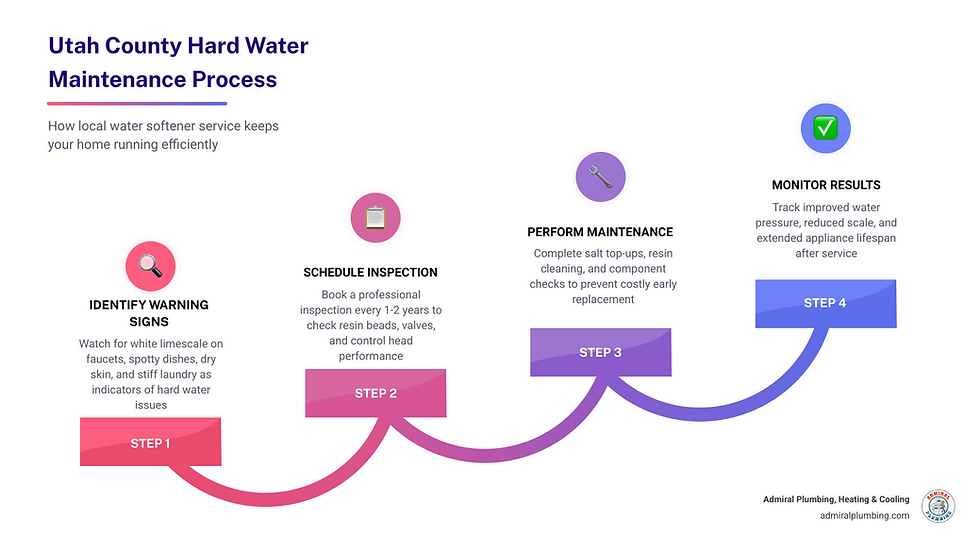
Signs You Need Professional local water softener service
Living in Northern Utah, your water softener is the unsung hero of your household. It works 24/7 to strip away the calcium and magnesium that naturally saturate our local groundwater. However, even the best systems can falter. If you start noticing that your "soft" water feels a bit more "crunchy" than usual, it’s time to look for the warning signs.
One of the most obvious red flags is the return of limescale. If you see white, chalky mineral buildup on your bathroom faucets or showerheads, your softener isn't doing its job. This buildup isn't just an eyesore; it’s a sign that the same minerals are clogging up your internal plumbing.
Other signs include:
Soap Scum: If your soap doesn't lather properly or leaves a film on your skin and tub, the minerals have returned.
Dry Skin and Hair: Hard water strips the natural oils from your body, leaving you itchy and your hair feeling brittle.
Stiff Laundry: If your towels feel like sandpaper and your clothes look faded, the resin in your softener may be failing.
Spotty Dishes: Cloudy glassware and spots on silverware are classic symptoms of hard water breakthrough.
If you’re seeing these issues, it’s time to look into Water Softener Repair to get your system back in peak condition.
Troubleshooting Common Issues with local water softener service
Before you panic, some issues can be identified with a quick visual check. One of the most common "DIY" fixes is addressing a salt bridge. This is a hard crust that forms in the brine tank, creating an empty space between the salt and the water. If the salt can't dissolve, the system can't regenerate. You can often break these up carefully with a broom handle, but if they keep coming back, your humidity levels or salt type might be the culprit.
Beyond salt bridges, we often see issues with resin beads. These tiny beads are what actually grab the minerals. Over 10–15 years, they can break down or become "fouled" by iron and sediment. We also frequently deal with clogged valves or a malfunctioning control head. The control head is the "brain" of the unit; if it loses its programming or the motor fails, the whole system grinds to a halt. A professional Water Softener Inspection is the best way to pinpoint whether it’s a simple clog or a mechanical failure.
Benefits of Regular local water softener service
Why bother with a tune-up if the water still feels "okay"? Because local water softener service is about more than just bubbles in the sink; it’s about protecting your biggest investments.
Appliance Protection: Hard water is the number one enemy of your dishwasher, washing machine, and water heater. By keeping your water soft, you prevent scale from coating heating elements, which can increase water heater efficiency by up to 30%.
Energy Efficiency: When your water heater doesn't have to fight through an inch of rock to heat your water, it uses significantly less energy.
Plumbing Lifespan: Soft water prevents the "narrowing" of pipes caused by mineral scale, maintaining your home’s water pressure for decades.
Think of Water Softener Tune-Ups like an oil change for your car. A little maintenance now prevents a massive repair bill later.
Comparing Water Softeners and Salt-Free Conditioners
When shopping for a local water softener service, you’ll likely hear the terms "softener" and "conditioner" used interchangeably. In the industry, they are actually very different technologies.
A traditional water softener uses a process called ion exchange. It literally swaps calcium and magnesium ions for sodium ions. The minerals are physically removed from the water and flushed down the drain. This is the only way to get that "slippery" soft water feel and completely eliminate scale.
A salt-free conditioner, on the other hand, doesn't remove the minerals. Instead, it "conditions" them (often using citric acid or poly-phosphate) so they don't stick to your pipes. While this is great for the environment and people on low-sodium diets, it won't give you the same cleaning benefits as a true softener. For many Utah homes, a Nuvo Whole Home Filter Dual Filter offers a great middle ground by combining high-level filtration with scale prevention.
Choosing the Right System for Utah Water
Utah water is notoriously "heavy." Choosing the right system depends on your specific "Grains Per Gallon" (GPG) count.
Feature | Salt-Based Softener | Salt-Free Conditioner |
Mineral Removal | Removes 99% of Calcium/Magnesium | Does not remove minerals |
Scale Prevention | Excellent | Good |
Water Feel | "Slippery" and soft | Traditional "hard" feel |
Maintenance | Requires salt refills | Requires cartridge changes |
Best For | High GPG (Utah standard) | Moderate hardness/Low sodium needs |
For most families in Provo, a high-capacity unit like the Sentry 48k Grain Water Softener is the gold standard because it can handle the high mineral volume found in our local supply without needing to regenerate every single night.
Professional Water Testing and Sizing
Don't guess when it comes to your water. A professional local water softener service starts with a lab-grade water test. We look at more than just hardness; we check for iron, chlorine, and total dissolved solids (TDS).
Sizing is equally important. A system that is too small will wear out its resin bed in a few years because it’s constantly working. A system that is too large is a waste of money. We calculate the right size based on your household size and your average daily water usage (typically 75 gallons per person). When you book Water Softener Installation Services, we ensure the flow rate matches your home's needs so you never experience a drop in pressure when the shower and dishwasher are running at the same time.
Investment Guide: Costs and Lifespan in 2026

Let’s talk numbers. It’s 2026, and while technology has improved, the costs of high-quality plumbing have remained relatively stable. Investing in a local water softener service is one of the few home improvements that actually pays for itself over time through reduced soap usage (up to 50% less!) and lower energy bills.
Typical Service and Installation Expenses
The average cost to install a new water softener system in Utah is roughly $1,500. However, depending on the complexity of the job, we see a range from $200 (for a simple swap-out) to $6,000 (for high-end, multi-stage filtration and softening systems).
Labor for these installations typically ranges from $150 to $1,000. Why the gap? If your home is already "pre-plumbed" for a softener (common in newer Provo builds), the labor is minimal. If we have to cut into your main water line, install a drain line, and run electrical, it takes more time.
For repairs, most homeowners spend between $150 and $600. We always recommend checking out our Water Softener Maintenance options to catch small issues before they become $600 headaches. We also offer various financing options to make sure every home in Northern Utah can afford clean, soft water.
Factors Affecting System Longevity
A high-quality water softener should last between 10 and 15 years. But that "15" is a best-case scenario. Several factors can shorten that lifespan:
Water Hardness: The harder your water, the more "cycles" your resin beads go through, wearing them out faster.
Maintenance Frequency: Systems that aren't cleaned or inspected often suffer from "resin fouling" or salt buildup in the valves.
Unit Quality: Big-box store models are often made with plastic components that don't hold up as well as professional-grade systems.
If your system is pushing the 12-year mark and starting to require frequent repairs, it might be more cost-effective to look into Water Softener Replacement rather than sinking more money into an aging unit.
Choosing a Reputable Provider in Northern Utah
When you’re looking for a local water softener service, you want more than just a guy with a pipe wrench. You need a technician who understands the specific water chemistry of the Wasatch Front.
At Admiral Plumbing, Heating & Cooling, we pride ourselves on being "brand agnostic." While some dealers will only touch their own proprietary brands, a reputable local provider should be able to service almost anything. Whether you have a high-end custom system or a unit you bought at a local hardware store, our licensed technicians have the training to fix it. We also offer 24/7 emergency service because we know that a leaking water softener doesn't wait for business hours to start flooding your basement. Check out our full Water Softeners Category for more details on the systems we support.
Service Plans vs. Individual Repairs
We often get asked: "Should I just pay as I go, or sign up for a plan?"
Individual repairs are fine for brand-new systems, but as a unit ages, the benefits of a service plan become clear. Our Water Softener Maintenance Plans usually include:
Annual Inspections: We check the valves, clean the brine tank, and test the water.
Priority Service: If your system goes down, you're at the front of the line.
Discounted Parts: If a motor or sensor fails, you aren't paying full retail.
Brand Compatibility and Parts Availability
One of the biggest frustrations for homeowners is buying a system from a "big box" store and then finding out no one will service it. We make it a point to offer Expert Water Softener Service for all makes and models, including:
Standard retail brands (Morton, GE, Whirlpool, etc.)
Professional-grade systems (Sentry, Nuvo, etc.)
Older or discontinued models (even if the manufacturer is out of business, we can often find universal parts)
Frequently Asked Questions about Water Softener Care
How often should my water softener be professionally serviced?
Beyond your monthly task of checking the salt level, we recommend a professional inspection every 1 to 2 years. During this visit, a technician will perform a "regeneration check," clean the venturi and nozzle, and ensure the salt settings are still accurate for your current water usage.
Can a local technician service any brand of water softener?
Yes! While some national franchises try to lock you into their proprietary parts, most water softeners use standard valve designs (like Fleck or Clack). A qualified local water softener service provider like us can source parts for almost any system on the market.
Does a water softener make drinking water taste salty?
This is a common myth! While the system uses salt to clean the resin beads, it doesn't "add salt" to your drinking water in a way you can taste. The amount of sodium added is minimal—often less than what you’d find in a slice of white bread. However, if you are on an extremely strict low-sodium diet, we can discuss Custom Water Softener Systems that use potassium chloride or pair your softener with a Reverse Osmosis system for the purest possible drinking water.
Conclusion
Your home’s plumbing is its circulatory system, and hard water is like cholesterol—it clogs things up until the system fails. By investing in a quality local water softener service, you’re protecting your home, your skin, and your wallet.
At Admiral Plumbing, Heating & Cooling, we’ve spent years helping Provo residents navigate the challenges of Utah’s hard water. With our A+ BBB rating and 24/7 emergency service, we’re always here when you need us. Don't let mineral buildup win the battle for your pipes.
Schedule your local water softener installation today and feel the difference that truly soft water makes!


Comments